
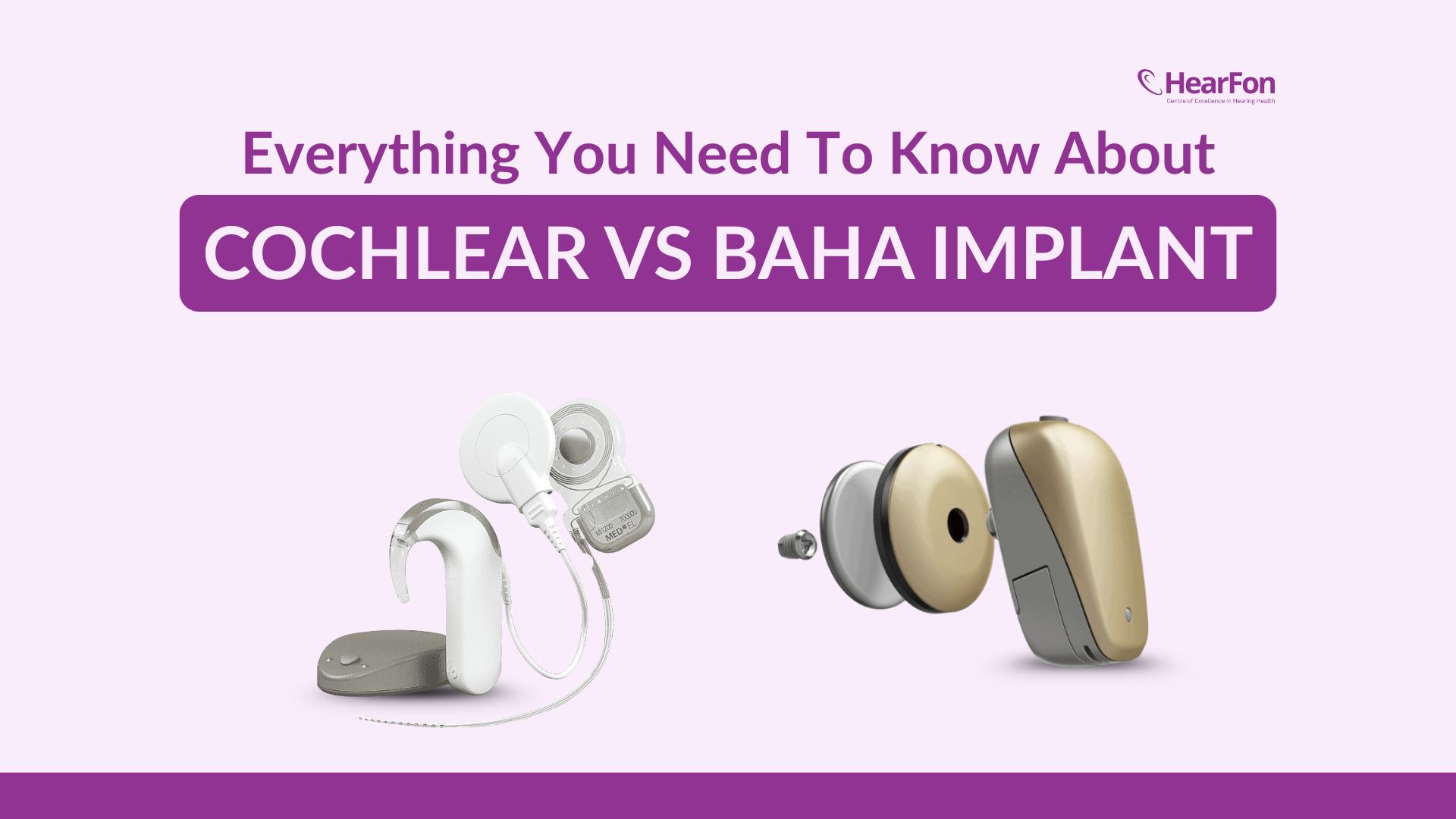
Hearing loss affects millions worldwide, and for some individuals, conventional hearing aids aren’t sufficient. In such cases, implantable devices like cochlear implants and bone‑anchored hearing aids (BAHA / bone conduction implants) offer more advanced solutions. While both are surgical devices intended to improve hearing, their mechanisms, indications, benefits, risks, and costs differ significantly.
In this article, we compare BAHA vs cochlear implant in depth — their functioning, pros/cons, and how to decide which may be appropriate.
What Is A BAHA?

A BAHA (Bone Anchored Hearing Aid) is a type of implantable hearing device that uses bone conduction to deliver sound vibrations to the inner ear (cochlea), bypassing the external auditory canal and middle ear. It is not a full cochlear implant, but rather a prosthetic system for hearing loss where sound conduction through the outer/middle ear is compromised.
BAHAs are especially used in cases of conductive hearing loss, mixed hearing loss, or single-sided deafness (SSD) where the inner ear (cochlea) and auditory nerve are intact and functional.
3 Main Components Of BAHA

A BAHA (or bone conduction implant system) generally comprises three main components:
1. External Sound Processor:
A small device that captures environmental sound, converts it into vibrations.
2. Connector/Coupling (Abutment Or Magnet):
This links the external processor to the implanted portion. Some systems use a direct abutment (a small rod protruding through the skin), while others use a magnetic “Attract” coupling design (transcutaneous) where the processor attaches over the skin via magnets.
3. Titanium Implant (Osseo Integrated Fixture):
Surgically embedded into the mastoid bone behind the ear, this implant integrates with the skull bone and conducts vibrations to the inner ear (cochlea).
Some systems use a magnet under the skin instead of a percutaneous abutment, reducing skin complications but potentially at some loss of vibration efficiency.
How Does The BAHA System Work?
- The external sound processor picks up ambient sound and converts it into mechanical vibration (rather than amplifying sound waves through air).
- The vibration is transmitted via the coupling (abutment or magnet) to the titanium implant anchored in the skull bone.
- The implanted fixture passes the vibration through the skull bone to the cochlea of the inner ear (on either side). Because bone conduction bypasses the outer and middle ear, it works even if those parts are damaged.
- The cochlea then processes the vibration (via its hair cells and fluid movement) and transmits signals via the auditory nerve to the brain, creating the perception of sound. Note: the system does not electrically stimulate the nerve — it relies on the cochlea’s residual function.
Thus, BAHA is effective only if the cochlea and auditory nerve remain functional. This is why bone anchored hearing aid vs cochlear implant decisions depend primarily on whether the inner ear and auditory nerve are intact.
What Is A Cochlear Implant?

A cochlear implant (CI) is a surgically implanted electronic device that directly stimulates the auditory nerve within the cochlea, bypassing damaged or nonfunctional inner-ear (hair cell) structures. It is used for individuals with severe to profound sensorineural hearing loss who derive little or no benefit from conventional hearing aids.
Unlike BAHA, which preserves the natural cochlear mechanism, cochlear implants convert sound into electrical signals and directly stimulate the auditory nerve fibers.
The External And Internal Components Of Cochlear Implant
A cochlear implant system consists of external and internal parts:
External Components:

- Microphone: captures sounds from the environment.
- Speech processor (or sound processor): converts captured sound into digital signal and then encodes it into electrical stimulation patterns.
- Transmitter (coil) / coil & magnet assembly: transmits encoded signal across the skin via electromagnetic induction to the implanted receiver.
Internal (Implanted) Components:

● Receiver-Stimulator:
Placed under the skin behind the ear, it receives the electromagnetic signal and converts it to electrical impulses.
● Electrode Array:
A set of electrodes inserted within the cochlea, along its spiral, to deliver electrical pulses to different regions along the cochlear nerve.
These components work in concert to bypass damaged hair cells and stimulate the auditory nerve directly.
How Does Cochlear Implant Work?
The functioning of a cochlear implant proceeds in these steps:
- Sound is captured by the microphone and sent to the speech processor.
- The processor analyses and codes the sound into a pattern of electrical impulses tailored to the wearer’s hearing map.
- The transmitter coil communicates the coded signal wirelessly to the implanted receiver-stimulator under the skin.
- The internal stimulator sends electrical pulses via the electrode array into different positions within the cochlea.
- The electrodes stimulate the appropriate auditory nerve fibers corresponding to different frequencies (tonotopic mapping).
- The auditory nerve transmits these signals to the brain, which interprets them as sound.
- Over time and with training, the brain learns to make sense of the new input, improving speech understanding, sound localization, and environmental awareness.
- Because this process bypasses dysfunctional hair cells or inner ear damage, cochlear implants can restore a sense of hearing even when traditional hearing aids fail.
If you’d like to understand the cochlear implant journey in more detail – including costs, recovery, and aftercare – here’s a helpful guide on cochlear implant cost & recovery.
BAHA vs Cochlear Implant: A Detailed Comparison
| Parameter | BAHA / Bone‑Anchored Hearing Aid | Cochlear Implant |
| Features | Uses bone conduction to transmit vibrations via skull to cochlea; external processor, coupling (abutment or magnet), and implant | Uses electrical stimulation of auditory nerve via electrodes; external microphone/processor, internal stimulator, electrode array |
| Benefits / Advantages | • Simpler surgery (often local anesthesia) with lower invasiveness • Useful in conductive/mixed hearing loss or SSD where cochlea is intact • External device can be removed, and skin coupling options • Lower cost vs cochlear implant in many settings • Fewer risks compared to deep inner ear surgery | Cochlear implant benefits include:• Can benefit severe-to-profound sensorineural hearing loss • Direct stimulation of auditory nerve yields better speech discrimination in many cases • Offers hearing in ears where natural cochlear function is lost • Many users achieve conversational speech recognition without visual cues • Upgradable external components over time |
| Cons / Limitations | • Cannot help if cochlea or auditory nerve is nonfunctional • Vibration transmission has limits in severe sensorineural loss • Skin complications at abutment site (infection, irritation) • Magnetic coupling may slightly reduce energy transfer efficiency • Does not restore “normal” hearing; hearing clarity limited | • More complex surgery with greater risks • High cochlear implant cost compared to BAHA • Requires careful mapping and rehabilitation over months/years • Possible complications: injury to facial nerve, meningitis, CSF leak, device failure etc. • May lose residual hearing in implanted ear • Some users describe “robotic” or synthetic sound initially • External components (microphone, battery) must be managed and kept dry |
| Costing & Affordability | Generally lower in cost; device and surgery are less complex. (Specific BAHA implant cost varies widely and depends on implant model, coupling method, and country). | High cost. In India, cochlear implant cost (device + surgery + rehab) typically range from ₹ 5 lakh to ₹ 14 lakh (≈ US$5,000–17,000) depending on hospital, brand, etc.Insurance coverage may offset costs; many government/NGO programs help children in some regions. |
| Who are they suited for? | • Patients with conductive or mixed hearing loss • Those with outer or middle ear anomalies (e.g. chronic ear disease, atresia) • Single-sided deafness (cross‑bone conduction) • Those whose cochlea and auditory nerve remain functional • Patients seeking less invasive options | • Patients with severe to profound sensorineural hearing loss who do not benefit from hearing aids • Cases where hair cells are damaged but auditory nerve is intact • Some pediatric candidates (infants/toddlers) to support speech development • People willing to commit to rehabilitation and mapping |
| Risks & Complications | • Skin irritation or infection at abutment site • Soft tissue overgrowth, skin breakdown around implant • Implant failure or loosening • Minor surgical risks: bleeding, wound issues • In magnet‑based systems: magnetic interference, lower coupling • Limit on power—very severe hearing loss may not be adequately addressed | • Surgical risks: anesthesia complications, bleeding, wound infection • Facial nerve injury or temporary facial weakness • Meningitis (rare) • CSF leak • Device failure or migration • Loss of residual natural hearing • Tinnitus, dizziness, taste disturbance, numbness around ear • Need for revision surgery • Incompatibility with MRI under certain conditions • They may set off metal detectors or interfere with security systems |
How To Choose Between BAHA & Cochlear Implant?
Selecting between BAHA and cochlear implant depends on multiple factors:
1. Type Of Hearing Loss:
If the primary issue is in the outer or middle ear (conductive/mixed loss) and the inner ear (cochlea) is healthy, BAHA may suffice. But if the inner ear is severely damaged (sensorineural loss), cochlear implant is likely required.
2. Residual Cochlear / Nerve Function:
Cochlear implant requires a functional auditory nerve. If the nerve is damaged or absent (retrocochlear pathology), CI may not help. In such cases, other options such as auditory brainstem implant may be explored.
3. Degree Of Hearing Loss/Speech Scores:
When hearing aids fail and speech perception with conventional amplification is very poor, cochlear implant is often the next step.
4. Medical Risks / Surgical Fitness:
If a patient is medically unfit for the more invasive cochlear implant surgery, BAHA (being comparatively simpler) may be safer.
5. Budget / Resources / Support:
Because cochlear implants are more expensive and require long-term rehabilitation (mapping, auditory-verbal therapy), patients must assess affordability and long‑term follow-up support.
6. Expectation And Motivation:
CI demands commitment to rehabilitation, mapping visits, auditory training. Patients must have realistic expectations (it does not restore “perfect” natural hearing).
7. Anatomical Constraints:
If the cochlear anatomy is abnormal or inaccessible, CI may be not feasible; BAHA may still function.
8. MRI And Other Imaging Needs:
Some implant systems limit MRI compatibility; this factor must be considered if the patient may require imaging in future.
In practice, ENT surgeons, audiologists, and implant teams evaluate these factors using detailed audiological tests, imaging (CT/MRI of temporal bones), nerve integrity tests, speech perception assessments, and overall patient health to recommend the best option.
So, Which Is Better – BAHA or Cochlear Implant?
Cochlear implants and BAHA systems are powerful tools in the management of hearing loss, but they address fundamentally different problems. BAHA (bone‑anchored hearing aid) harnesses bone conduction to bypass outer and middle ear defects when the cochlea is functional. Cochlear implants, on the other hand, electrically stimulate the auditory nerve to bypass damaged inner-ear structures in severe sensorineural loss.
There is no one-size-fits-all solution. The ideal choice depends on the type of hearing loss, residual nerve function, surgical risk profile, financial considerations, and patient motivation for rehabilitation. While BAHA may offer a less invasive, lower-cost option for certain cases, cochlear implants remain the standard for profound inner-ear hearing loss, offering better speech understanding potential but at higher complexity and expense.
If you’re considering either option, the best path is a comprehensive evaluation at a specialized cochlear implant center including audiology, imaging, counseling, and long-term support. If you’re unsure which option aligns with your hearing needs, a hearing consultation with HearFon can provide clear, personalized guidance. Only then can you weigh BAHA vs cochlear implant in your particular scenario and choose the solution that offers you the best possible quality of hearing and life.